
Interactive Toys for Bored Indoor Cats: 2026 Guide


Table of Contents
- Why Bored Indoor Cats Need Interactive Toys
- How to Keep Indoor Cats Entertained: A Rotation Strategy
- Best Interactive Cat Toys for Bored Indoor Cats
- Automatic Cat Toys for Solo Play
- Puzzle Feeders for Cats: Mealtime as Mental Stimulation
- Age-Specific Toy Recommendations and Safety Tips
- DIY Enrichment and Toy Cleaning: Budget-Friendly Tips
- Frequently Asked Questions
Last Updated: September 1, 2026
Why Bored Indoor Cats Need Interactive Toys
Indoor cats live longer, safer lives than their outdoor counterparts, but lose access to the rich sensory world that keeps feline brains sharp. Without outlets for prey drive and hunting instinct, cats develop real behavioral problems.
Interactive toys aren't a luxury, they're essential for maintaining cognitive health, managing weight, and preventing destructive behavior.
According to the American Association of Feline Practitioners' enrichment guidelines, environmental enrichment is a core component of feline preventive care. The right combination of toys, puzzle feeders, and a rotation strategy can address most boredom-related issues.
Signs Your Cat Is Understimulated
Watch for these patterns: excessive sleeping beyond 16 hours with no active play, destructive behavior like scratching furniture or chewing cords, attention-seeking behaviors like yowling or biting, overeating, aggression toward other pets, and repetitive behaviors like pacing. If you're seeing two or more of these, your cat is telling you something.
How to Keep Indoor Cats Entertained: A Rotation Strategy
The biggest mistake cat owners make is leaving a great toy out permanently. Within days, even engaging toys become invisible. Cats habituate quickly to static stimuli but remain engaged by novelty. A rotating library of six to eight items, swapped every two to three days, keeps the environment fresh without constant new purchases.
| Rotation Slot | Toy Type | Swap Frequency | Best Time of Day |
|---|---|---|---|
| Slot 1 | Electronic self-play toy | Every 2-3 days | Morning |
| Slot 2 | Puzzle feeder | Daily (mealtime) | Feeding times |
| Slot 3 | Wand or feather toy | Daily (interactive) | Evening |
| Slot 4 | Crinkle tunnel or activity board | Weekly | Afternoon |
| Slot 5 | Catnip toy | Every 3-4 days | Any |
| Slot 6 | Treat-dispensing ball | Daily (mealtime) | Feeding times |
Cats need both solitary play (battery-operated toys) and interactive play with their owner. Wand toys specifically satisfy the social hunting instinct that solo toys can't replicate.
Best Interactive Cat Toys for Bored Indoor Cats
The toys below were selected for their ability to engage prey drive, sustain independent play, and hold up to regular use.
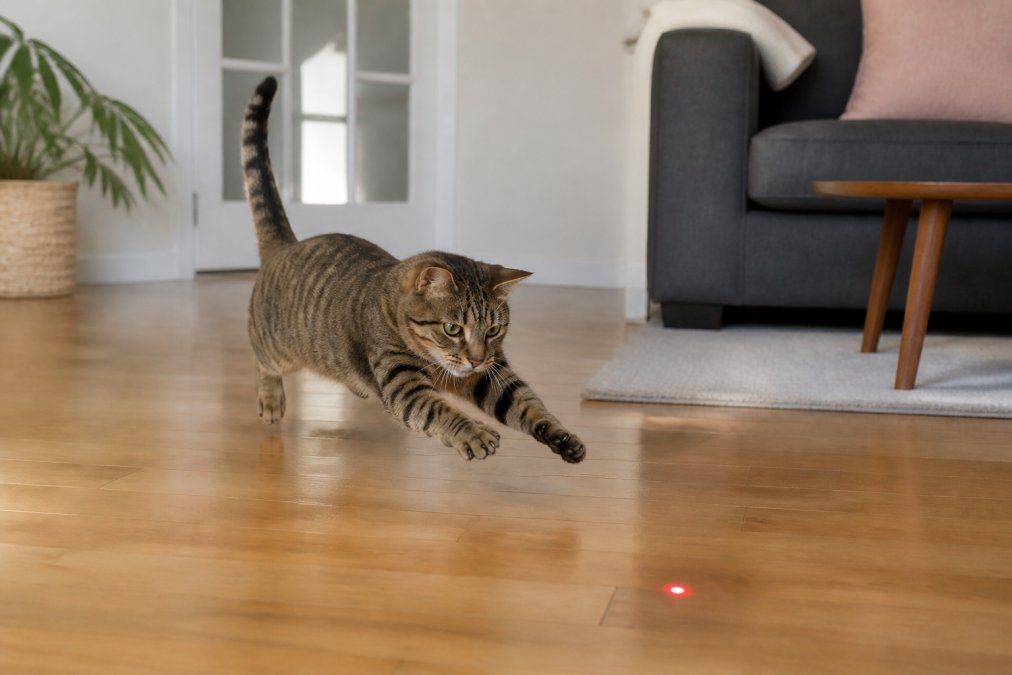
Quick Picks:
- Best laser toy: PetSafe FroliCat BOLT, hands-free, 15-minute auto shutoff
- Best concealed motion toy: SmartyKat Hot Pursuit, mimics hidden prey realistically
- Best dual-laser option: Premier Pet Automatic Multi-Laser, two lasers for higher engagement
- Best manual puzzle: Pioneer Pet SmartCat Peek-a-Prize Toy Box, durable wood, works with any toy or catnip
1. PetSafe FroliCat BOLT Interactive Laser Cat Toy
The FroliCat BOLT is the standard-setter for automatic laser toys. It projects random laser patterns across floors, walls, and ceilings with an adjustable mirror. The automatic shutoff after 15 minutes prevents overstimulation, cats that chase lasers without catching prey can develop frustration behaviors.
Best for: Cats who enjoy chasing laser pointers and owners who need hands-free options during work hours.
Pros: Automatic and manual modes, 15-minute auto shutoff, adjustable mirror for varied play surfaces.
Cons: Requires 4 AA batteries (not included). Some cats frustrate from inability to physically catch the laser.
2. SmartyKat Hot Pursuit Electronic Concealed Motion Cat Toy
The Hot Pursuit moves a faux fur wand unpredictably under a rustling fabric cover, replicating hidden prey. This taps into primal hunting instinct more effectively than a laser beam. Two speed settings match the toy to your cat's energy level.
Best for: Cats motivated by hunting hidden prey, especially those who ignore laser pointers.
Pros: Realistic prey movement, two speed controls, auditory and visual stimulation combined.
Cons: Requires 3 AA batteries (not included). Fabric cover wears with aggressive play.
3. Premier Pet Automatic Multi-Laser Cat Toy
This toy runs two lasers simultaneously at random speeds and directions, providing enough unpredictability to sustain engagement in high-drive cats. The wide base prevents tipping, and the 15-minute automatic shutoff matches the BOLT's safety feature.
Best for: Highly active cats and multi-cat households where two cats can chase simultaneously.
Pros: Two lasers for increased engagement, random speed and pattern variation, automatic shutoff.
Cons: Requires 3 AA batteries (not included). Cats that frustrate easily may still need a physical "catch" toy nearby.
4. Pioneer Pet SmartCat Peek-a-Prize Toy Box
This sturdy wooden box has strategically placed holes for a cat's paw. Load it with small toys, catnip, or treats, and the cat fishes them out. The problem-solving element engages foraging behavior in ways chasing a laser doesn't. It's silent, making it ideal for nighttime enrichment.
Best for: Cats who enjoy problem-solving and need mental stimulation beyond physical chasing.
Pros: Durable wood construction, works with any small toy or treat, encourages natural predatory and foraging behavior.
Cons: May not appeal to cats with low toy motivation. Not recommended for small kittens whose paws can't reach the holes.
Automatic Cat Toys for Solo Play
Automatic toys are the backbone of enrichment for working pet owners, sustaining engagement across a full workday without your presence.
PETLIBRO Automatic Interactive Cat Toy
The PETLIBRO moves in random directions with obstacle avoidance sensors, mimicking erratic prey movement. Its smart auto on/off cycle (10 minutes active, 30 minutes resting, up to 160 minutes total) prevents habituation. The USB rechargeable battery eliminates mid-session battery swaps.
Best for: Cats who enjoy chasing moving objects and need engaging independent play during the day.
Pros: Intelligent obstacle avoidance, USB rechargeable, BPA-free materials, auto on/off cycle prevents habituation.
Cons: May move too fast for timid or senior cats. Battery life varies with usage frequency.
Puzzle Feeders for Cats: Mealtime as Mental Stimulation
Puzzle feeders are one of the most underused enrichment tools. Instead of eating from a bowl in 90 seconds, a cat spends 10 to 20 minutes working for the same food portion, activating foraging behavior and cognitive engagement.
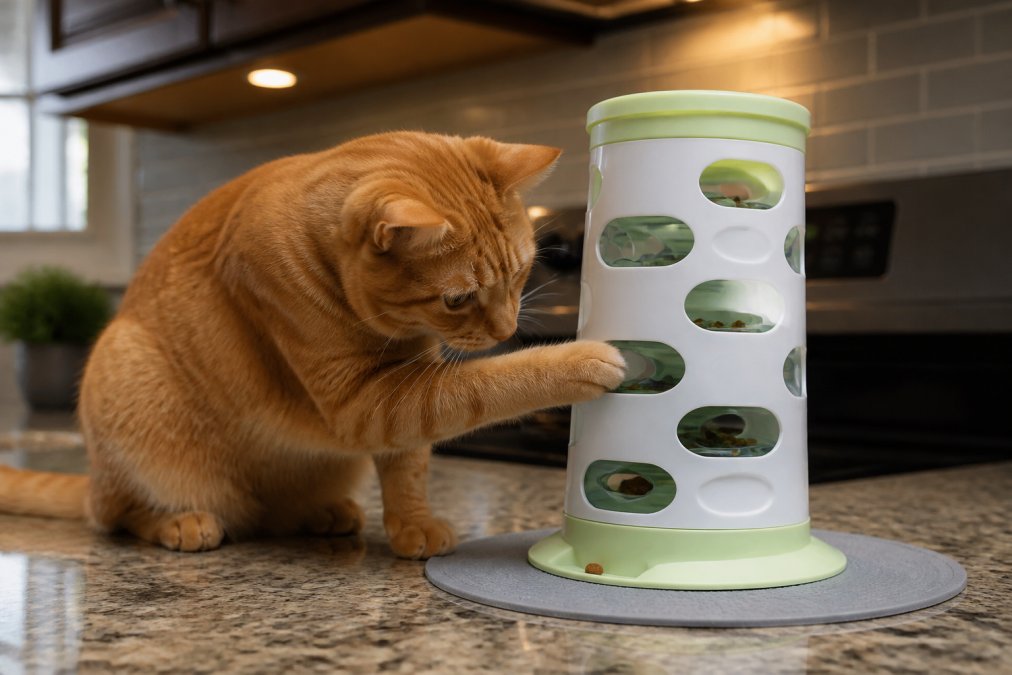
According to the Ohio State University Indoor Pet Initiative, feeding enrichment is one of the most effective interventions for reducing stress and unwanted behaviors in indoor cats.
PetSafe SlimCat Interactive Food Dispenser
The SlimCat is the entry point for puzzle feeding: a simple ball with adjustable openings that dispenses kibble as the cat bats it around. It holds up to 2/3 cup of dry food and is BPA-free and dishwasher safe.
Best for: Overweight cats, fast eaters, and cats new to puzzle feeding.
Catit Senses 2.0 Food Tree
The Food Tree takes puzzle feeding vertical. Cats paw kibble through openings at different levels. Three adjustable difficulty levels let you scale the challenge as your cat improves. The stable base prevents tipping.
Best for: Cats who eat too quickly and those ready for higher-difficulty puzzle feeders.
Doc & Phoebe's Indoor Hunting Cat Feeder
This veterinarian-designed system includes three mouse-shaped feeders to replace the food bowl entirely. You fill each mouse with a portion of the day's kibble and hide them around the house. The cat hunts for its meals, addressing the root cause of many behavioral issues linked to boredom.
Best for: Cats with behavioral issues linked to boredom, overeating, or anxiety.
OurPets IQ Treat Ball
The IQ Treat Ball functions similarly to the SlimCat but with adjustable learning levels offering wider difficulty range. It twists apart for easy filling and cleaning. Primarily marketed for dogs, it works equally well for cats and is practical for multi-pet households.
Best for: Multi-pet households and cats who enjoy working for treats during independent play.
| Puzzle Feeder | Difficulty Levels | Best For | Cleaning |
|---|---|---|---|
| PetSafe SlimCat | Adjustable openings | Beginners, fast eaters | Dishwasher safe |
| Catit Senses 2.0 Food Tree | 3 levels | Intermediate puzzlers | Fully disassembles |
| Doc & Phoebe's Hunting Feeder | Natural foraging | Behavioral issues | Hand wash |
| OurPets IQ Treat Ball | Adjustable levels | Multi-pet households | Twist-apart |
Age-Specific Toy Recommendations and Safety Tips
Kittens vs. Adult Cats vs. Seniors
Kittens (under 1 year): Need high-frequency, high-intensity play to burn energy and develop coordination. Wand toys with feather attachments and lightweight balls are ideal. Avoid small parts that can be swallowed and long strings that pose entanglement risks.
Adult cats (1-7 years): Toy selection should follow individual personality. High-drive cats benefit from electronic toys and laser systems. Lower-energy cats respond better to puzzle feeders and activity boards.
Senior cats (7+ years): Reduced mobility and arthritis may develop. Interactive play remains important for cognitive health, but intensity should decrease. Puzzle feeders provide mental stimulation without demanding physical exertion. According to ASPCA guidance on senior cat care, maintaining mental stimulation in older cats supports cognitive function and quality of life.
Pet-Safe Materials and Supervision Guidelines
Look for these markers when evaluating any toy: BPA-free plastic, non-toxic dyes and finishes, no small parts that can be chewed off and swallowed, sturdy construction with no sharp edges, and strings stored away after interactive play.
Never shine a laser directly into a cat's eyes. The toys reviewed here use low-power lasers designed for pet use, but aim them at floors and walls, not the cat's face.
DIY Enrichment and Toy Cleaning: Budget-Friendly Tips
Many effective feline enrichment tools cost almost nothing.
DIY enrichment ideas:
- Paper bags and cardboard boxes: Leave a paper grocery bag open or cut entry holes in a cardboard box. Rotate new boxes weekly.
- Crinkle tunnels from packaging: Shape mylar or crinkle material into a loose tunnel.
- Homemade puzzle feeders: A muffin tin with kibble in each cup, covered by tennis balls, or a cardboard egg carton with kibble in each compartment.
- Window enrichment: Position a cat tree near a bird feeder outside a window for visual stimulation.
- Catnip sock toys: Fill an old sock with dried catnip and tie it off. Refresh catnip every few weeks.
Cleaning and maintenance schedule:
Dirty toys are a hygiene issue and behavioral one, cats often reject toys with accumulated grime or cleaning product scent.
| Toy Type | Cleaning Method | Frequency |
|---|---|---|
| Plastic puzzle feeders | Dishwasher or hand wash with mild soap | After every use |
| Fabric toys and wands | Spot clean, air dry | Weekly |
| Wooden toys (Peek-a-Prize) | Wipe with damp cloth, air dry | Weekly |
| Electronic toys | Wipe exterior with damp cloth | Weekly |
| Catnip toys | Replace catnip filling | Every 3-4 weeks |
A smaller number of well-chosen, well-maintained toys outperforms a drawer full of ignored ones. For cats that have stopped responding to their current rotation, the fix is usually one of three things: the toys need cleaning, the rotation needs refreshing, or the cat needs a different category of toy entirely.
Cornell Feline Health Center's guide to indoor cat enrichment recommends regular environmental changes as one of the most effective tools for maintaining feline behavioral health. Rotating toys, rearranging furniture occasionally, and introducing new scents all count.
Interactive toys for bored indoor cats work best as a system, not a single purchase. The cats that thrive indoors are the ones whose owners treat enrichment as an ongoing practice rather than a one-time fix.
Frequently Asked Questions
What are the best toys for a bored indoor cat?
The best interactive cat toys address a cat's prey drive directly. Automatic laser toys like the PetSafe FroliCat BOLT satisfy the chase instinct hands-free, while concealed-motion toys like the SmartyKat Hot Pursuit mimic hidden prey. Puzzle feeders add cognitive challenge by making cats work for meals. The most effective approach combines two or three toy types and rotates them weekly so your cat stays curious rather than tuning them out.
Do interactive toys actually help with cat anxiety?
Yes. Regular interactive play lowers stress hormones and reduces anxiety-driven behaviors like over-grooming, hiding, or aggression. Toys that engage a cat's hunting instinct, such as wand toys, concealed-motion toys, and puzzle feeders, give indoor cats an outlet for energy they would otherwise spend on destructive behavior. Even 10 to 15 minutes of focused play twice a day produces noticeable behavioral improvements in most cats within a few weeks.
How often should I rotate my cat's toys?
Rotating toys every five to seven days keeps stimulus variety high and prevents habituation. Store unused toys in a sealed bag with a pinch of catnip, then reintroduce them the following week. Cats respond to a 'new' toy with the same excitement as a first encounter, so rotation is one of the cheapest enrichment strategies available. Keeping three to four toy categories in regular rotation, such as laser, puzzle feeder, and wand, covers the full range of feline enrichment needs.
Are automatic cat toys safe to leave on while I'm away?
Most automatic cat toys for solo play include built-in timers and auto-shutoff features specifically designed for unsupervised use. The PETLIBro mouse toy runs for 10 minutes then rests for 30, while laser toys like the FroliCat BOLT shut off after 15 minutes. Always check that the toy is made from pet-safe, BPA-free materials before leaving it unattended. Remove any toy with small detachable parts that could be swallowed when you are not home.
How do puzzle feeders for cats differ from regular treat-dispensing balls?
Treat-dispensing balls like the PetSafe SlimCat or OurPets IQ Treat Ball reward cats for rolling and batting, which adds physical exercise to mealtime. Puzzle feeders like the Catit Senses 2.0 Food Tree or Doc & Phoebe's Indoor Hunting Feeder focus more on cognitive problem-solving, requiring cats to paw, reach, or search for food across multiple locations. Both categories slow eating and reduce the risk of overeating, but puzzle feeders tend to provide deeper mental stimulation for cats with high foraging instincts.
Keeping an indoor cat mentally and physically engaged is one of the most consistent challenges pet owners face, and the right tools make a real difference. Paws & Claws carries a carefully selected collection of interactive toys, puzzle feeders, and enrichment accessories chosen by lifelong pet lovers who understand that quality and thoughtfulness matter more than volume. Browse the full collection at Paws & Claws and add the toys that fit your cat's personality to your cart today.
This article was written using GrandRanker