
How to Find Durable Dog Toys That Survive Chewers


Table of Contents
- Why Most 'Indestructible' Dog Toys Fail in a Week
- The 4-Step Method for How to Find Durable Dog Toys
- Durable Toys for Aggressive Chewer Dogs: What Actually Holds Up
- Safest Materials for Dog Toys: A Non-Toxic Cheat Sheet
- Signs a Dog Toy Needs to Be Replaced
- The Repair and Recycle Route for Worn Toys
- Conclusion: Buy Smarter, Not Just Tougher
- Frequently Asked Questions
Last Updated: September 7, 2026
Every pet parent knows the scene: a toy marketed as "indestructible" becomes a pile of stuffing and plastic shards within a week. Learning how to find durable dog toys isn't about grabbing the thickest rubber; it's about matching material science to your dog's jaw strength. At Paws & Claws, we offer a carefully selected collection of high-quality toys to help you make smarter choices.
Durability is a combination of material density, shape, and size, a toy that survives a Labradoodle may not last an hour with a Pit Bull. Below, we'll walk through a practical framework for selecting tough toys, explain which materials are safest, and show when to retire a toy before it becomes a choking hazard.
Why Most 'Indestructible' Dog Toys Fail in a Week
The marketing promise of "indestructible" is a trap. No toy is truly indestructible because every material has a fatigue point, and aggressive chewers will find it. Most failures happen because the toy is the wrong type for the dog's chewing style, not because the material is inherently weak.
Many toys fail due to a mismatch in play style. A dog that shreds fabric needs a different toy than one with high bite force. If you buy a toy for mental stimulation but your dog is a solitary power chewer, the toy will lose, the failure isn't the product, it's the selection process.

The 4-Step Method for How to Find Durable Dog Toys
Finding a toy that survives requires a systematic approach that balances the dog's behavior, the material's physical properties, and the toy's geometry. Following these steps reduces wasted money and keeps your pet safer during solo play.
Step 1: Match the Toy to Your Dog's Destruction Pattern
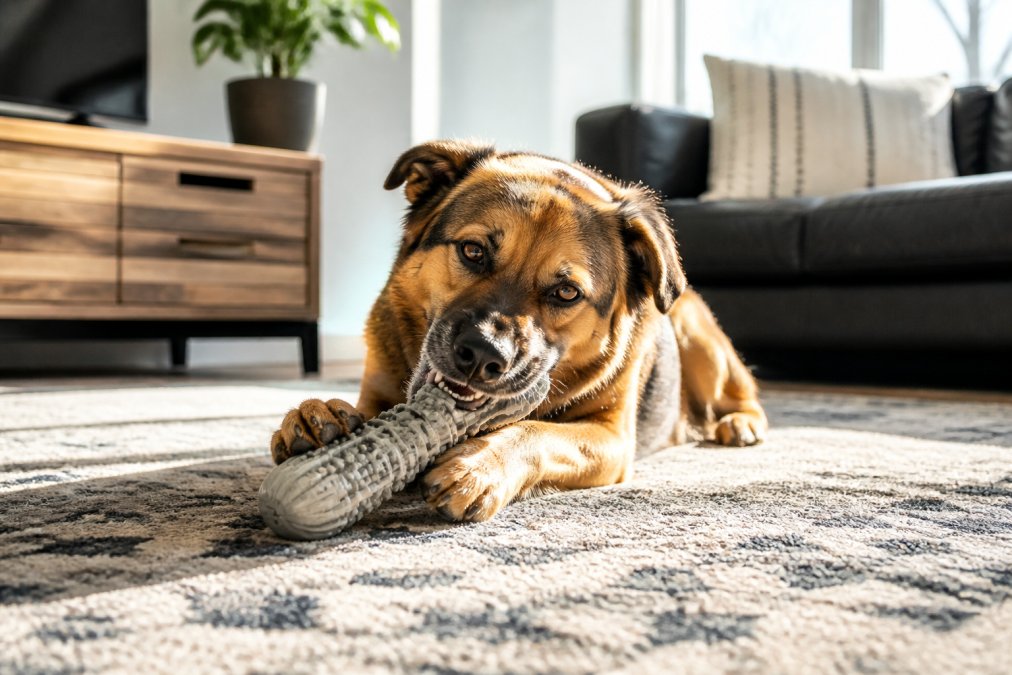
Before buying anything, diagnose how your dog destroys toys. There are three distinct patterns: the "Shredder" who pulls apart fibers and seams, the "Power Chewer" who uses immense jaw strength to crack hard materials, and the "Gulper" who tries to swallow pieces whole.
Shredders need supervised interactive play with rope or plush. Power Chewers need solid, single-material toys with high puncture resistance. Gulpers require toys too large to fit entirely in the mouth. Identifying this pattern tells you which material density you need before you look at a price tag.
Step 2: Read the Label for Material Density
Material density is the single biggest predictor of longevity. When learning how to find durable dog toys, check the label for the specific material rather than vague terms like "heavy-duty." Natural rubber and dense nylon are the gold standards for aggressive chewers due to their high tear strength and puncture resistance.
Thin latex or standard thermoplastics are low-density and will fail quickly. Look for toys labeled non-toxic, BPA-free, and phthalate-free. Denser materials distribute bite pressure, preventing the tooth from sinking in and tearing a chunk off.
Step 3: Size Up Based on Jaw Pressure
Size is not just about preventing choking; it's about use. A toy too small for your dog's mouth concentrates all bite force onto one small area. A larger toy forces the dog to chew on the ends, reducing their mechanical advantage to snap it.
For large breeds, the toy should be significantly larger than their mouth. For puppies or small dogs, the toy must be large enough that they cannot fit the whole thing in the back of their throat. When in doubt, sizing up is safer and more durable.
Step 4: Stress Test at Home Before You Trust It
You don't have to wait for the toy to fail. Try to bend it forcefully and see if it flexes or cracks. Press your thumbnail into the surface; if it indents easily, your dog's teeth will likely puncture it just as fast.
For nylon bones, check for sharp edges as the dog wears it down. For rubber, ensure it doesn't flake. A toy that passes your initial stress test is far more likely to survive the first few weeks of heavy use.
Durable Toys for Aggressive Chewer Dogs: What Actually Holds Up
When you have a dog that chews to destroy, narrow your focus to proven categories. The best durable toys for aggressive chewer dogs are almost exclusively made from high-density nylon or natural rubber, offering puncture resistance without splintering into dangerous shards.
Nylon Bones vs. Natural Rubber for Heavy Chewers
Nylon bones are exceptionally hard and long-lasting, ideal for extreme power chewers. They are flavor-infused to keep the dog engaged and help scrape away plaque. However, they are rigid; if your dog is not a dedicated chewer, they may lose interest quickly.
Natural rubber is more forgiving and offers a little bounce, appealing to dogs who like to shake or toss toys. It provides more "give" than nylon, which is gentler on teeth but still resists tearing. A rotation of both materials works best for most heavy chewers.
When Rope Toys Are the Right Choice
Rope toys serve a specific purpose: they are excellent for interactive play like tug-of-war and help clean teeth. They are only durable when the dog is not a dedicated Shredder.
For dogs who chew to destroy fabric, rope fibers can be ingested, leading to intestinal blockages. For moderate chewers, a high-quality cotton or hemp rope toy offers a different texture that satisfies the urge to gnaw without cracking teeth. The Cotton Hemp Dog Toy Set from Paws & Claws ($21.76) is a sustainable option for these dogs.

Safest Materials for Dog Toys: A Non-Toxic Cheat Sheet
Safety must always come before durability. The safest materials for dog toys are non-toxic, free from harmful chemicals, and won't splinter into sharp shards or leach chemicals during a vigorous chew session.
What BPA-Free and Phthalate-Free Actually Mean
BPA (bisphenol A) hardens polycarbonate plastics, while phthalates soften PVC and other plastics. Both are endocrine disruptors (the NIH). The FDA has banned BPA in baby bottles and sippy cups, but no similar federal ban exists for pet toys (the FDA).
When a toy is labeled BPA-free and phthalate-free, the manufacturer has avoided these specific risks. However, "BPA-free" does not automatically mean the toy is free of other bisphenols like BPS or BPF.
Material-by-Material Safety Breakdown
Natural rubber (latex from the Hevea brasiliensis tree): This is the gold standard for durable, safe chewing. It is biodegradable, free of synthetic plasticizers, and has high tear strength. The main concern is a true latex allergy, which is rare but possible; if your dog shows facial swelling or hives, switch to an alternative.
Food-grade nylon: Nylon is a synthetic polymer that is extremely hard and resistant to puncture. Food-grade nylon is manufactured without fillers or recycled content that can introduce unknown chemicals. It is not digestible, so it must be monitored for wear, ingested shavings typically pass through but can cause gastric irritation in sensitive dogs.
Thermoplastic elastomers (TPE): TPE sits between rubber and plastic. It is softer than nylon, more flexible than natural rubber, and often marketed as "flavor-infused." Look for TPE labeled food-safe or FDA-compliant for food contact, as some lower-grade TPEs contain mineral oil extenders that can leach out.
Cotton and hemp rope: These natural fibers are digestible in small amounts and generally safe. The risk is mechanical, if a dog swallows a long strand, it can cause a linear foreign body obstruction. Rope toys should only be used under supervision and retired at the first sign of fraying.

Materials to Skip for Aggressive Chewers
Certain materials should be avoided entirely for power chewers:
- Thin vinyl or latex: Easily punctured and torn, producing swallowable pieces.
- Polyester fiberfill (plush stuffing): Not digestible and can cause intestinal blockages when consumed in volume.
- Squeakers: Often made of thin PVC or metal reeds; both can be extracted and swallowed whole.
- Hard plastics with seams: Injection-molded toys with visible seams are weak points that crack under pressure, producing sharp edges.
- Rawhide: Not digestible, can swell in the stomach, and is often treated with bleach and chromium during processing.
- Antler and bone (for power chewers): While natural, these are harder than tooth enamel and are a leading cause of slab fractures in molars.
The Thumbnail Test and the "Give" Rule
A practical safety check used by veterinary dentists: press your thumbnail into the toy. If it doesn't indent at all, it is harder than the dog's tooth enamel and risks dental fractures. If it indents too easily, it will tear apart quickly. The sweet spot is a material with slight "give", enough to absorb impact but dense enough to resist puncturing. Natural rubber and high-quality TPE typically pass this test; nylon and antler do not.
The ASTM F963 Standard: A Useful Benchmark
While there is no federal safety standard specific to dog toys, many reputable manufacturers voluntarily test against ASTM F963, the Standard Consumer Safety Specification for Toy Safety. This standard covers physical hazards, chemical toxicity, and small-part choking risks (astm.org). When a manufacturer states their toy is "ASTM F963 compliant," it has been tested for lead, cadmium, and other heavy metals, and small parts are securely attached.
A Quick Reference: Safe vs. Unsafe Materials
| Material | Safe for Power Chewers? | Key Risk | Best Use Case |
|---|---|---|---|
| Natural rubber | Yes | Latex allergy (rare) | All-purpose durable chewing |
| Food-grade nylon | Yes | Tooth fracture if too hard | Extreme power chewers who don't bite down on hard surfaces |
| TPE (food-safe) | Yes | Mineral oil leaching in low grades | Moderate chewers who like bounce |
| Cotton/hemp rope | No (supervised only) | Linear foreign body | Tug-of-war and dental cleaning |
| Vinyl/latex | No | Tearing and ingestion | Not recommended |
| Rawhide | No | Blockages and chemical residue | Not recommended |
| Antler/bone | No | Dental fractures | Not recommended for power chewers |
Choosing a toy free of harmful chemicals is essential for aggressive chewers because increased surface area and saliva exposure can increase chemical leaching. When in doubt, contact the manufacturer directly and ask for their material safety data sheet (MSDS) or third-party testing results.
Signs a Dog Toy Needs to Be Replaced
No toy lasts forever, and knowing when to retire one is crucial. The most obvious sign is visible wear and tear: cracks, chunks missing, or exposed internal fibers. Once compromised, a toy loses its structural integrity and becomes easier to break into swallowable pieces.
If a nylon bone develops sharp, jagged edges, it can cut your dog's gums. If a rubber toy starts to flake, those pieces can be ingested. Inspect toys weekly and replace them at the first sign of significant damage. Supervise your dog during the first few play sessions to gauge how quickly they break it down.
The Repair and Recycle Route for Worn Toys
Before tossing a damaged toy, consider if it can be salvaged. Many rope toys can be re-knotted to remove frayed ends. For rubber toys with minor surface wear, a quick wash and inspection might be all they need.
When a toy is beyond repair, recycle it properly. If you cannot recycle the material, dispose of it securely so your dog cannot access it from the trash.
Conclusion: Buy Smarter, Not Just Tougher
Finding toys that survive isn't about spending more money; it's about applying a logical framework to your dog's specific needs. By matching the toy to the destruction pattern, checking material density, and sizing appropriately, you can avoid the cycle of weekly replacements. Prioritize non-toxic materials and always supervise new toys until you are confident they are safe.
At Paws & Claws, we curate our selection to ensure every item balances durability, safety, and enrichment. Explore our collection of heavy-duty toys, from the Indestructible Dog Toy for Large Dogs ($19.99) to our eco-friendly rope sets, and give your chewer something that actually lasts. Add to cart and find the toy that survives your furry friend.
Frequently Asked Questions
What dog toys are most durable for aggressive chewers?
For aggressive chewers, solid nylon bones and dense natural rubber toys hold up best. Look for materials that resist puncture and tearing rather than those with soft stuffing or thin vinyl. Our Indestructible Dog Toy for Large Dogs uses solid nylon with textured ends, designed to withstand heavy bite force and shredding. Avoid toys with seams that can be pried open, and always match the toy size to your dog's jaw.
Are there any dog toys that are actually indestructible?
No toy is truly indestructible for every dog. A determined chewer can eventually damage almost anything. The goal is to find toys with a long replacement cycle, not a lifetime guarantee. Solid nylon and thick natural rubber offer the best durability rating for heavy chewers. Check toys regularly for signs of wear, and replace them when they show damage to prevent choking hazards.
How do I choose the right size toy for my dog?
Choose a toy that is larger than your dog's mouth to prevent accidental swallowing. A toy that is too small becomes a choking hazard for aggressive chewers. For large breeds with strong jaw strength, select toys labeled for large or extra-large dogs. For puppies up to 25 pounds, smaller rope toys are safer. When in doubt, size up rather than down.
What materials are safest for heavy chewers?
The safest materials for heavy chewers are solid, non-toxic options like natural rubber and virgin nylon that are BPA-free and phthalate-free. These materials have high material density and tear strength, making them difficult to shred. Avoid toys with soft plastic or thin latex that can break into sharp pieces. Always supervise first play sessions to confirm your dog's chewing style suits the toy.